
A Great Experience Is Not Enough if the Business Model Lacks Focus
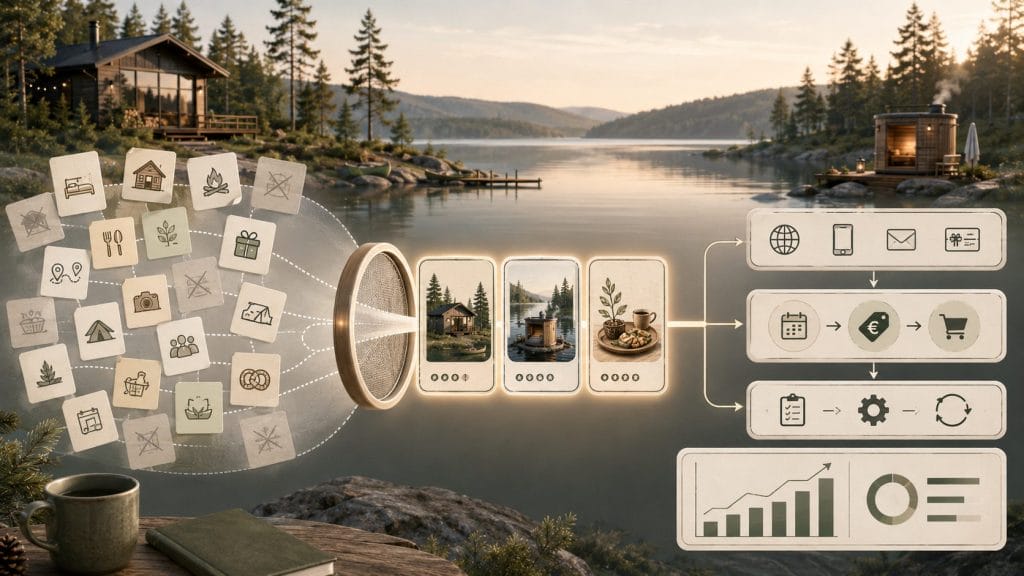
The experience economy is based on the idea that customers do not simply buy a product or service but an experience that is meaningful to them. Pine and Gilmore (1998) described this shift as one in which a company’s role is not merely to provide a service but also to create the stage and script for the experience. From a business model perspective, however, the critical question is how that experience is turned into an experience product that customers can buy, that can be priced appropriately, and that can be delivered repeatedly.
The value of an experience does not automatically translate into business results. Prahalad and Ramaswamy (2004) emphasize value co-creation: value emerges through interaction between the customer and the company rather than solely through the company’s internal production. Vargo and Lusch (2008) take a similar view in service-dominant logic, arguing that value emerges through use and experience rather than simply residing in a finished product.
For an experience-based business, the value co-creation perspective is highly practical.
Customers can perceive an experience as valuable only when they understand what they are buying, why the offering suits them, and what kind of experience they will receive. Customer-perceived value must be articulated, productized, and priced so that the experience can actually be purchased. Otherwise, the experience remains part of the entrepreneur’s expertise, the atmosphere of a place, or a promising idea that has yet to generate revenue.
An Idea Is Not Yet a Business Model
In an experience-based business, a new idea can immediately sound promising. A guided activity could be added to accommodation. An event could include an additional service. The story of a location could become a guided tour. A group could be offered a workplace wellness day. A new event could be created for the low season. Existing customers could be offered a meal, sauna experience, workshop, encounter with animals, or cultural content as part of a broader experience.
A business model begins only when the idea is connected to revenue generation. Teece (2010) defines a business model as the way a company creates and delivers value to customers while capturing a portion of that value for itself. Zott et al. (2011) emphasize that a business model is the overall logic of how a company operates, not merely a product, strategy, or organizational structure.
In an experience-based business, the business model begins to lose focus when every possibility remains open at the same time. The same customer may be offered multiple potential experience products, each product may target several customer segments, each customer segment may require several channels, and every channel may come with its own unfinished to-do list.
From the outside, the company may appear creative and versatile. From the inside, however, the entrepreneur’s time can easily be consumed by a situation in which no experience product is ever fully completed, visible, and available for purchase. A structured financial review can help stop this fragmentation. Instead of continuing to add possibilities, the discussion should shift toward the next commercially sound choice: which experience product should be brought to market first?
Lack of Focus Undermines Profitable Growth
A lack of focus can initially look like growth. The company designs new services, considers target customers, talks with partners, adds content to its website, and tests events. Development feels active. From a business perspective, however, activity alone is not enough if it does not lead to experience products customers can buy, increased sales, and improved profitability.
The limited resources of a small experience-based business make a lack of focus particularly risky. The entrepreneur may simultaneously be responsible for customer service, marketing, sales, delivering experiences, cleaning, managing partners, finances, the website, social media content, and planning the next season. Every new idea adds tasks. Every unfinished experience product consumes attention and time. Every unclear channel increases the workload.
Creativity turns into business only when the entrepreneur can make choices. This might mean identifying the three most important experience products, making one premium product the flagship offering, systematically offering add-on services to existing customers, or bringing an off-season experience product to market first. Making a choice can also mean deciding not to pursue something now, even when the idea itself is attractive.
Giving something up, however, is often more difficult than adding a new idea. A company may have experience products, operating practices, or customer segments that have become familiar and difficult to abandon even though they no longer strengthen the business. In such cases, the problem may not be the new idea at all. It may be an old offering that continues to consume time, capacity, and attention that could be directed toward more profitable opportunities.
The business model therefore needs to be viewed periodically through the customer’s eyes.
What is still meaningful to the customer? What matters to the entrepreneur but remains unclear to the customer? What requires a great deal of work relative to the return it generates? And what established practice is preventing a new source of customer appeal from being incorporated without undermining profitability?
This type of review can feel uncomfortable, but it helps distinguish the company’s genuine strengths from familiar practices that keep the entrepreneur busy without supporting growth. Prioritization becomes especially important when the company has many promising ideas, but development is constrained by the entrepreneur’s time, unfinished marketing, missing product descriptions, unclear pricing, or the fact that the experience product is not yet available for customers to buy. The ideas do not need to disappear. They need to be put in order. (Bergström 2025–2026.)
Growth Requires an Experience Product Customers Can Buy
Making an experience product easy to buy is an often underestimated prerequisite for growth. Customers cannot buy an idea that exists only in the entrepreneur’s mind. They buy an experience product they can find, understand, and book.
Lemon and Verhoef (2016) emphasize that the customer experience develops throughout the customer journey. The experience begins before the customer ever arrives: with how they first hear about the experience product, the impression they form, how easily they can find additional information, how smoothly the booking process works, and how expectations develop before the visit. For an experience product, the purchasing process itself is part of the customer experience.
From a commercial perspective, making an experience product easy to buy requires at least five things. The product must have a name that communicates something meaningful to the customer. Its description must explain what the customer will experience, see, do, or receive. The price must be visible or at least easy to obtain. The booking or inquiry process must be clear. And the experience product must be available in the channel where that particular customer is likely to look for it.
In many small experience-based businesses, the problem is not service quality but an unclear purchasing process. Add-on services exist, but they are not offered at the right point in the customer journey. An event idea is good, but the event is not on the calendar. A group product would suit corporate customers, but the website does not present a clear offering for groups. A gift certificate could generate sales during slower periods, but customers cannot purchase it easily.
Making an experience product available for purchase is not a technical detail. It is at the core of the business model. Once the product is clearly presented, the entrepreneur can market it, customers can make a purchase decision, partners can recommend it, and sales can be tracked.
Value Must Be Turned into Something Customers Can Buy
A business model remains incomplete if the value created for customers exists only in the entrepreneur’s mind or as part of generally good service. Customers may be willing to pay for privacy, uniqueness, safety, expert guidance, storytelling, local character, convenience, or a complete experience that has already been designed for them. From the company’s perspective, however, value begins to generate returns only when it becomes visible in the product description, price, sales channel, and purchasing path.
The added value created by the entrepreneur often already exists but remains invisible. A tour, story, guidance, extra attention, or a special customer interaction may be included in the basic service without its value being reflected in the price, packaging, or product description. From a financial perspective, the problem arises when the added value created for customers is reflected neither in the price nor in the margin. (Bergström 2025–2026.)
Articulating value helps both the customer and the entrepreneur. Customers understand more clearly why an experience product costs more than a basic service. The entrepreneur sees that the price is based not only on costs but also on customer-perceived benefits and the distinctive qualities of the experience. The business model becomes stronger when added value stops being an invisible by-product of good service.
Add-On Sales May Be the Most Realistic Path to Growth
Not all growth requires a new experience product or a new customer segment. Often, the most realistic path to growth can be found within the existing customer journey: how could an existing customer purchase a clearer, broader, or more valuable package? From a business model perspective, add-on sales are not an isolated sales tactic. They are a way to make better use of existing customer relationships, capacity, and company strengths.
Add-on sales work only when they are designed from the customer’s perspective. An unrelated extra product may feel like nothing more than an attempt to sell more. An additional service offered at the right moment, on the other hand, can improve the experience. A welcome message, booking confirmation, website package, event-day signage, or clearly described group offering can help customers choose more without making the sales effort feel forced.
Prahalad and Ramaswamy’s (2004) concept of value co-creation helps put add-on sales in the right perspective. The customer is not a passive buyer but participates in shaping the experience. When the company provides options, customers can tailor the experience to suit their own needs. An add-on service is therefore not merely a way for the company to increase revenue. At its best, it gives customers the opportunity to deepen, extend, or personalize their experience.
Opportunities for add-on sales are often found within the existing customer journey. Growth does not always need to begin by finding a new customer base or developing an entirely new experience product. Often, the first step is to serve existing customers more clearly from a commercial perspective and make the next purchasing opportunity visible. (Bergström 2025–2026.)
Place Alone Does Not Create a Business Model
Many experience-based businesses are built around the distinctive qualities of a place. Nature, a building, history, animals, a lake view, tranquility, local character, or the entrepreneur’s own story may form the core of the experience. The location may be the company’s strongest competitive advantage. At the same time, it can obscure the business model if the entrepreneur assumes that customers will understand its value without further explanation.
In a place-based business, value does not arise solely from the company’s own service. In experience products built around nature, landscape, local character, and seasons, the customer experience is also shaped by weather, time of year, the surrounding environment, the attractiveness of the destination, and the customer’s own expectations. A clear value proposition helps define what the company can promise, what the customer will experience, and how the overall experience can be delivered reliably (Sørensen et al. 2025).
A place alone is not an experience product. It must be turned into an experience customers can buy. The story must be written in the customer’s language. The route must be designed. Meals, guidance, sauna experiences, workshops, or other content must be integrated into a coherent whole. Experience design must also account for weather, safety, accessibility, and customer expectations. Preparation, quality assurance, and the entrepreneur’s expertise must also be incorporated into the overall experience.
The strongest source of value in an experience-based business may be precisely what feels too ordinary to the entrepreneur. An outside perspective can often help identify what customers find exceptional in the company’s everyday environment and what they might be willing to pay more for.
Choices Turn Ideas into Sales
A financial review is not only about calculations. The purpose of the numbers is to support decisions. When entrepreneurs assess price, margin, group size, seasonality, add-on sales, and their own workload, the discussion shifts from an idea to a business model.
Santarsiero et al. (2024) emphasize the importance of digital transformation, innovation, and management in renewing tourism business models. In small companies, however, renewal does not always take the form of a major strategic program. It may involve a highly practical decision: choose one experience product, write the product description, set the price, add a booking option, activate the right sales channel, and monitor sales.
Decision-making becomes easier when the entrepreneur separates three questions. The first is the creative question: what could the experience be? The second is the commercial question: who will buy it, and at what price? The third is the delivery question: can the company deliver the experience with consistent quality, repeatedly, and profitably?
A lack of focus often develops when these questions become mixed together. The entrepreneur becomes excited about a new idea before the previous one is available for purchase. The price is set before customer value has been articulated. Sales channels are discussed before the experience product itself is clear. A structured financial review puts the questions back in the right order: first choose, then articulate the value, then set the price, then bring the product to market, and finally measure the results.
Metrics Reveal Whether Growth Is Actually Happening
In developing an experience-based business, the amount of activity can be misleading. Social media posts are published, the website is updated, events are planned, and new ideas keep emerging. What matters for growth is whether all this activity translates into sales.
Metrics help distinguish activity from results. Not every company needs the same metrics. The right measure depends on how the company expects to grow. If growth is expected from group sales, the company should track the number of group bookings, average price, and actual sales revenue. If growth is expected from add-on services, it should track the percentage of customers purchasing add-ons and additional sales per customer. If growth is expected from events, it should track participant numbers, average transaction value, and margin. If growth is expected from higher utilization, it should track bookings, length of stay, and off-season sales.
A good metric is understandable to the entrepreneur and connected to action. It must indicate what the entrepreneur should respond to. If group bookings are not coming in, marketing or the sales channel must change. If customers are not purchasing add-on services, the visibility, timing, or price of the offering must be reviewed. If customers are not signing up for an event, the product description, target customer, or timing of the sales effort must be reassessed.
The value of metrics is that they make growth measurable. Entrepreneurs no longer need to rely solely on whether development feels successful. They can see whether the selected experience products are generating bookings, add-on sales, higher utilization, or margin.
Focus Makes an Experience Scalable
Scalability can sound like language reserved for high-growth companies, but in an experience-based business it can mean very practical things. An experience product can be delivered more often without rebuilding the entire customer journey from scratch. A ready-made package can be sold to groups. The same add-on service can be offered consistently to every accommodation guest. A welcome message can handle part of the sales process. A clear product description reduces the need for individual explanations. A partner can recommend the experience product once they understand what it includes.
Focus does not reduce the company’s opportunities. It makes the best opportunities repeatable. Once an experience product has been named, priced, described, placed in the right sales channel, and made measurable, the entrepreneur can improve it based on actual experience. Customer feedback, booking volumes, add-on purchases, and profitability show whether the product should be strengthened, modified, or postponed.
A clearer business model ultimately becomes visible in the entrepreneur’s daily work. There are fewer decisions because everything does not have to be reinvented. Selling becomes easier because customers are offered a clear option. Pricing becomes stronger because the value has been articulated. Marketing becomes more precise because the target customer has been selected. Growth becomes possible because the next step is concrete.
In an experience-based business, a good idea is only the beginning. Profitable growth requires turning that idea into an experience product that fits the business model: it has a customer, a promise, a price, a channel, a delivery model, and a metric. Without these elements, the experience may be excellent for the customer but too fragmented, labor-intensive, or unprofitable for the company. A great experience is not enough if the business model lacks focus. A structured financial review helps entrepreneurs do the most difficult part: choose which idea to turn first into an experience product that can be sold profitably and measured.
This article is part of the Pricing Experience Products series.
What Does This Mean in Practice?
First decide what you are not going to do right now. Ideas rarely run out, but the entrepreneur’s time, money, and energy do. Three clear, sellable, and profitable experience products may move the business further forward than ten unfinished ideas.
Make the experience product easy to buy before moving on to the next idea. An experience product begins to generate returns only when customers can find it, understand its value, and purchase it. The product description, price, booking path, sales channel, welcome message, and add-on services are all part of the business model.
Measure growth, not just activity. Activity alone does not indicate profitable growth. Track bookings, add-on sales, group sales, participant numbers, utilization, average transaction value, and margin. Choose metrics based on where the company’s growth actually comes from.
Use of AI: ChatGPT was used to support the translation and language revision of this article. The author reviewed and approved the final text.
Lähteet
References
Bergström, H. 2025–2026. Working material from the financial review conducted in the Scaling Experiences project. Unpublished project material.
Lemon, K. N. & Verhoef, P. C. 2016. Understanding customer experience throughout the customer journey. Journal of Marketing, 80(6), 69–96. https://doi.org/10.1509/jm.15.0420
Pine, B. J. II & Gilmore, J. H. 1998. Welcome to the experience economy. Harvard Business Review, 76(4), 97–105. Available at: https://hbr.org/1998/07/welcome-to-the-experience-economy [accessed 10 June 2026].
Prahalad, C. K. & Ramaswamy, V. 2004. Co-creation experiences: the next practice in value creation. Journal of Interactive Marketing, 18(3), 5–14. https://doi.org/10.1002/dir.20015
Santarsiero, F., Carlucci, D. & Schiuma, G. 2024. Driving digital transformation and business model innovation in tourism through innovation labs: an empirical study. Journal of Engineering and Technology Management, 74, 101841. https://doi.org/10.1016/j.jengtecman.2024.101841
Sørensen, F., Jensen, J. F. & Grindsted, T. S. 2025. A business model framework for nature tourism entrepreneurs. Journal of Ecotourism, 24(2), 1–22. https://doi.org/10.1080/14724049.2024.2385774
Teece, D. J. 2010. Business models, business strategy and innovation. Long Range Planning, 43(2–3), 172–194. https://doi.org/10.1016/j.lrp.2009.07.003
Vargo, S. L. & Lusch, R. F. 2008. Service-Dominant Logic: continuing the evolution. Journal of the Academy of Marketing Science, 36(1), 1–10. https://doi.org/10.1007/s11747-007-0069-6
Zott, C., Amit, R. & Massa, L. 2011. The Business Model: Recent developments and future research. Journal of Management, 37(4), 1019–1042. https://doi.org/10.1177/0149206311406265
Lisenssi

Viittausohjeet
Bergström, H. 2026. Liipa laapa. Teko online publication. South-Eastern Finland University of Applied Sciences. Available at: https://urn.fi/URN:NBN:fi-fe20261127150904.