
Pricing an Experience Product Is Not Guesswork
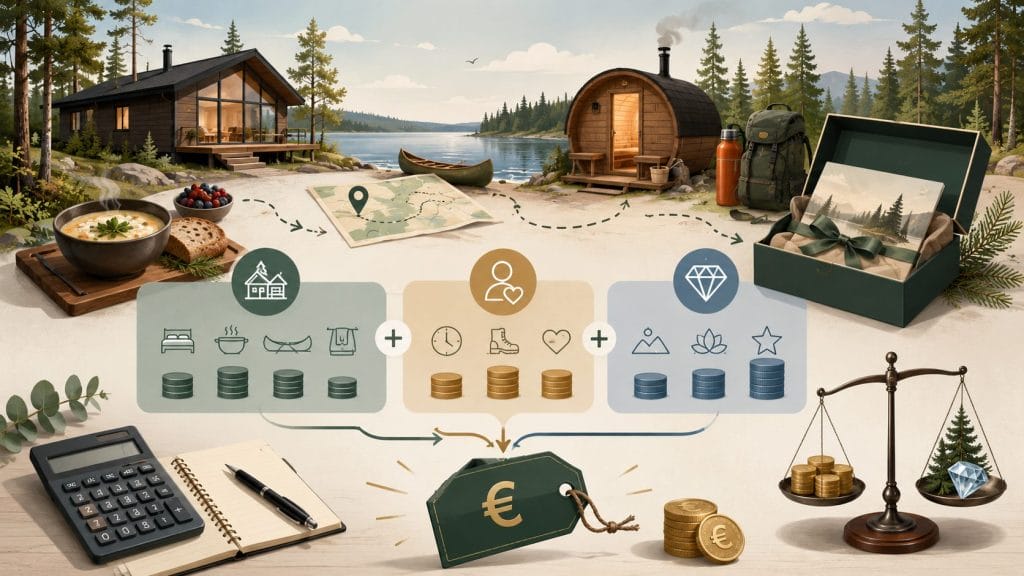
Pricing is often challenging for experience-based businesses because part of the value of an experience product is intangible. Customers pay not only for accommodation, meals, guidance, encounters with animals, nature excursions, courses, sauna experiences, or event tickets, but also for a break from everyday life, a lasting memory, time together, relaxation, a sense of accomplishment, a new perspective, or access to something they would not normally experience in their daily lives.
Pine and Gilmore (1999) help explain why this intangible value lies at the heart of pricing in the experience economy: a business is not simply selling a service performance but an experience that is meaningful to the customer.
Cost calculation is an essential starting point when pricing an experience product, but it is not enough on its own. If the price is based solely on costs, the entrepreneur may avoid the worst underpricing but still fail to capture some of the value created for the customer. If the price is based only on perceived customer value without understanding costs and the amount of work involved, the experience product may look attractive to customers while remaining financially weak for the business.
Pricing Starts with Making Costs Visible
The first fundamental pricing question is simple: what does it really cost to deliver the experience product? The cost of an experience product includes more than purchased materials, ingredients, facility rental, or fees paid to partners. It must also account for preparation, planning, marketing, customer communication, follow-up work, travel, cleaning, equipment maintenance, cancellation risks, seasonal fluctuations, and the entrepreneur’s own working time. If only the time visible to the customer is included in the price, the true profitability of the experience product is distorted.
In many experience-based businesses, the initial pricing situation is poorly structured. The idea behind the experience product may be clear, but the costs, workload, and minimum level of profitability behind the price can easily remain hidden. The price is then based on caution, previous pricing habits, or competitor comparisons rather than the company’s own cost structure. (Bergström 2025.)
This observation is also familiar from pricing research. Value-based pricing requires a company to understand both the value created for the customer and its own ability to deliver and demonstrate that value. Price is therefore not an isolated number but part of the business model (Christen 2024; Hinterhuber & Snelgrove 2022).
The Price Needs a Profitability Threshold
The second fundamental pricing question is how much remains for the company after variable costs and the work required to deliver the experience have been taken into account. A small business can generate sales and still price its work too low if preparation, customer communication, follow-up work, and the entrepreneur’s own time are not reflected in the price.
Important pricing insights often emerge when alternative prices, group sizes, workloads, and costs are compared side by side. The issue is not simply whether the price should be raised. The price of the experience product needs to support the long-term viability of the business rather than merely increase the amount of work. (Bergström 2025.)
Adequate profitability is a prerequisite for business continuity. Without it, the company cannot develop the experience product, invest in quality, hire additional help, market its services, or build a financial buffer for slower periods.
Customers Pay for Value, Not Costs
The third question concerns customer-perceived value. Customers compare the price with what they believe they will receive in return.
Customer value research commonly views value as the relationship between benefits and sacrifices. Benefits may be functional, emotional, social, or symbolic. Sacrifices include not only money but also time, effort, uncertainty, and the potential risk that the experience will not meet expectations. (Blut et al. 2024.) This perspective is particularly important for experience products because customers often pay for benefits that are difficult to describe as a simple list of product features.
Pricing value also requires understanding the target customer. The same experience product may seem like an expensive add-on to one customer and be the very reason another customer chooses the company. A family with children, a corporate group, an international traveler, a customer seeking well-being, or a visitor interested in local culture will evaluate the price on different grounds.
The more clearly a company understands whom the experience product is for and what benefits that customer is seeking, the better it can justify the price based on perceived customer value.
If a service description merely states that a package includes accommodation, meals, and a guided program, customers may see little more than a collection of cost items. If the same package is presented as a peaceful getaway, a creative day, a unique nature experience, a shared celebration, or an environment that helps an executive team focus, customers begin to understand why the package may be worth more than the sum of its individual components.
Articulating value does not mean using empty embellishment or creating artificial luxury. It means making customer-perceived value visible throughout the customer journey: in expectations before arrival, the welcome, personal interactions, the setting, the story, participation, the lasting memory of the experience, and opportunities to share it with others.
A Premium Price Needs a Premium Rationale
Many experience-based businesses have the potential to develop premium experience products, but premium positioning can easily remain little more than a label. A higher price does not result from simply calling an experience product luxurious. It comes from ensuring that the target customer, promise, content, customer journey, and quality of delivery are all aligned with the price.
With a premium experience product, customers need to understand why this particular experience is special. The rationale may relate to the location, limited availability, personalized service, expertise, storytelling, safety, aesthetics, tranquility, a sense of community, sustainability, or access to an environment that would otherwise be unavailable to the customer.
Premium thinking often becomes clearer when an entrepreneur moves away from selling an individual service and begins to view the offering from the customer’s perspective. Instead of asking, “What do we have to offer?” the entrepreneur asks, “What need, problem, or desire does this experience address for this particular customer?” As the target customer becomes more clearly defined, the rationale for the price becomes clearer as well. (Bergström 2025.)
According to the European Commission (2025), the transition in tourism emphasizes more sustainable, digital, and resilient operating models. For a small experience-based business, this also means being able to develop financially sustainable experience products that build on the company’s strengths, meet customer expectations, and generate an adequate margin.
Example Calculation: From a Basic Service to an Experience Product
The calculations in this article are hypothetical. They illustrate the logic of pricing and profitability and are not based on data from any individual company participating in the project.
Consider a small experience-based business that offers a three-hour group visit. The company has a distinctive setting, a story, relevant expertise, and the ability to provide a guided experience. Initially, the experience product is priced cautiously.
Table 1. Option A: A cautiously priced basic visit.
| Group size | 10 people |
| Price to customer | €45/person |
| Total sales | €450 |
| Variable costs | €120 |
| Entrepreneur’s preparation and delivery time | 5 hours |
| Margin before valuing the entrepreneur’s own work | €330 |
| Entrepreneur’s own work at a target rate of €50/hour | €250 |
| Remaining margin after the entrepreneur’s work | €80 |
At first, the basic visit appears reasonable: a three-hour group visit generates €450 in sales. However, once materials, refreshments, preparation, delivery, and follow-up work are included, actual profitability remains modest. If the entrepreneur values their work at even €50 per hour, only €80 remains to cover business development and risk.
Next, the same core service is redesigned as an experience package. A more clearly defined target customer is selected, the service promise is sharpened, pre-arrival communication is improved, and elements are added that are valuable to the customer without increasing costs at the same rate. The package might include a more personalized welcome, a story-driven tour, a short participatory activity, a taste of local food, and a carefully designed closing moment.
Table 2. Option B: An experience product packaged around customer value.
| Group size | 10 people |
| Price to customer | €95/person |
| Total sales | €950 |
| Variable costs | €220 |
| Entrepreneur’s preparation and delivery time | 6 hours |
| Margin before valuing the entrepreneur’s own work | €730 |
| Entrepreneur’s own work at a target rate of €50/hour | €300 |
| Remaining margin after the entrepreneur’s work | €430 |
In Option B, the price more than doubles, but the experience offered to the customer also changes. The experience product is no longer simply a visit but a more clearly defined and articulated experience. Variable costs and the entrepreneur’s workload increase, yet the margin remaining after the entrepreneur’s own work rises from €80 to €430.
Profitability does not improve simply because the price is increased. It improves because the experience product is redesigned: the target customer is more clearly defined, the value proposition is sharpened, the benefit perceived by the customer increases, and costs remain under control. Research on tourism pricing has also identified packaging and experience-based pricing strategies as attractive approaches from the customer’s perspective (Al-Moustafa et al. 2023).
Competitor Comparisons Help, but Should Not Dictate the Price
Monitoring competitors’ prices is useful, but it should not be the primary basis for pricing. Competitor comparisons show the pricing environment in which customers make decisions. They do not reveal how much the company’s experience product is worth to the customer or what price makes the experience product profitable for the business. In value-based pricing, the starting point is not simply competitors’ price levels but understanding, demonstrating, and communicating the value created for the customer. (Christen 2024; Hinterhuber & Snelgrove 2022.)
If a small experience-based business sets its prices solely according to local accommodation, course, event, or activity prices, it may end up competing in the wrong category. Customers may not compare the experience product with the nearest competing provider at all. Instead, they may compare it with alternative ways of spending their money: a weekend trip, a wellness service, a corporate wellness day, a celebration with friends, a cultural event, or a gift certificate.
Competitor comparisons therefore need to be accompanied by value comparisons. What does the customer gain from this particular experience? What makes it unique? What need does it address? What will the customer still remember afterward? What risk or effort does the company remove for the customer? When these questions remain unanswered, the price can easily feel too high to the entrepreneur. When the answers are articulated carefully, the same price may feel entirely justified to the customer.
Pricing Is Also About Making Choices
Pricing is also a way to set boundaries and make choices. When the sales potential, costs, workload, and price sustainability of an experience product are considered together, some ideas prove interesting but not yet commercially viable. Others quickly emerge as experience products worth developing further. (Bergström 2025.)
An important insight is that pricing is not merely the final step before selling. It is a development tool. When entrepreneurs examine an experience product through the numbers, they must ask:
- Who is the experience for?
- Why would the customer pay for it?
- How many times can the experience be delivered each year?
- How much of the entrepreneur’s own work does delivery require?
- What costs arise every time the experience is delivered?
- What needs to happen for the experience product to be profitable?
- At what price is the experience product justified for both the customer and the company?
Pricing is closely linked to strategic focus. Not every idea needs to be implemented. Not every customer needs to be served with the same experience product. Not every area of expertise needs to be packaged immediately. For a small experience-based business, the most profitable approach may be to identify one or two experience products where customer-perceived value, the entrepreneur’s expertise, and the business margin come together.
Price Reflects Confidence in the Experience Product
Pricing is a financial decision, but it is often also a psychological one. Many entrepreneurs know, in principle, that they could charge more. Raising the price can still feel difficult. The reasons may include fear of losing customers, uncertainty about their own expertise, established pricing habits, or the belief that customers in their region will not pay more.
The psychological dimension of pricing is especially visible when an experience product involves strong personal expertise, a unique setting, or an experience that holds particular meaning for the customer. To an outsider, the experience product may contain obvious sources of value that the entrepreneur has not yet priced in. Once the value is articulated, a higher price can begin to feel more realistic. (Bergström 2025.)
Improving pricing also means improving communication. The product description, images, name, customer journey, booking process, target customer, customer communication, and follow-up all influence how the customer perceives the price. If a premium experience product looks like a basic service online, customers will evaluate it against the price of a basic service.
Three Tests for the Price of an Experience Product
The price of an experience product can be evaluated using three tests: the cost test, the profitability test, and the value test.
The first is the cost test. Does the price cover all variable costs of the experience product, the entrepreneur’s work, and a reasonable share of the company’s overhead? If not, the price is too low, or the experience product needs to be redesigned.
The second is the profitability test. Does the price leave enough financial room for business development, marketing, risk, and slower periods? If the experience product creates more work but does not strengthen the company’s finances, either the price or the structure of the experience product needs to be reconsidered.
The third is the value test. Does the customer understand why the experience product costs what it does? If customers cannot see the difference between a basic service and an experience package, the problem may not be the price but how the value is communicated.
When all three tests are passed, the price is not guesswork. It is a well-founded business decision.
This article is part of the Pricing Experience Products series.
What Does This Mean in Practice?
- Calculate first—do not guess. Make variable costs, your own working time, preparation, delivery, follow-up work, and sales-related costs visible. If the entrepreneur’s work and the value created for the customer are missing from the price, the price will easily be set too low.
- Packaging can increase both value and margin. Do not sell only an individual service if you can create a more valuable package for the customer. Combine the core service, story, setting, interaction, additional services, and a lasting memory into an experience whose value is clear to the customer.
- A premium price requires a clear value proposition. A higher price works only when the target customer, customer journey, communication, and quality of delivery support it. Customers need to understand why this particular experience is special.
Use of AI: ChatGPT was used to support the translation and language revision of this article. The author reviewed and approved the final text.
Lähteet
References
Al-Moustafa, S. S., Hassan, T. H., Saleh, M. I., Helal, M. Y., Salem, A. E. & Ghazy, K. 2023. Unlocking Tourism’s Potential: Pricing Strategies for the Post-COVID Renaissance. Sustainability, 15(19), 14400. https://doi.org/10.3390/su151914400
Bergström, H. 2025. Working material from the financial review in the Scaling Experiences project. Unpublished project material.
Blut, M., Chaney, D., Lunardo, R., Mencarelli, R. & Grewal, D. 2024. Customer perceived value: A comprehensive meta-analysis. Journal of Service Research, 27(4), 501–524. https://doi.org/10.1177/10946705231222295
Christen, T. 2024. A structured review on the mechanisms of value-based pricing: towards a conceptual framework for new business how to operationalize it in practice. University of St. Gallen. Available at: https://www.alexandria.unisg.ch/handle/20.500.14171/119270 [accessed 9 June 2026].
European Commission. 2025. Transition pathway for tourism: taking stock of progress by 2024. Available at: https://transition-pathways.europa.eu/system/files/2025-05/Transition%20pathway%20for%20tourism_Taking%20stock%20of%20progress.pdf [accessed 9 June 2026].
Hinterhuber, A. & Snelgrove, T. C. 2022. Value First, Then Price: Building Value-Based Pricing Strategies. 2nd edition. Routledge.
OECD. 2024. OECD Tourism Trends and Policies 2024. OECD Publishing, Paris. https://doi.org/10.1787/80885d8b-en
Pine, B. J. II & Gilmore, J. H. 1999. The Experience Economy: Work Is Theatre & Every Business a Stage. Harvard Business School Press.
Lisenssi

Viittausohjeet
Bergström, H. 2026 Pricing an Experience Product Is Not Guesswork. Teko online publication. South-Eastern Finland University of Applied Sciences. Available at: https://urn.fi/URN:NBN:fi-fe20261127150815.