
Margin Determines Whether an Experience Product Is Viable
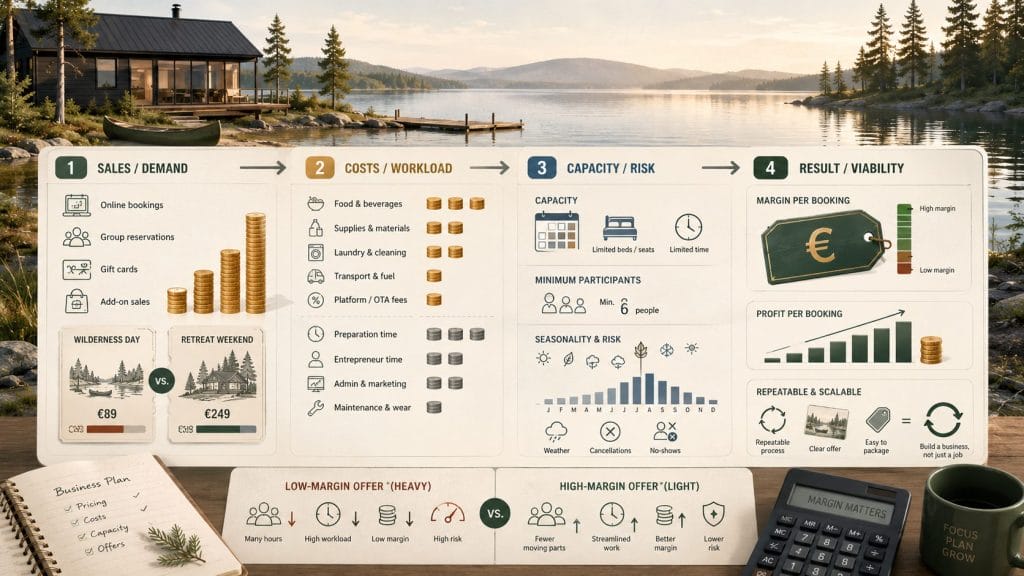
A classic premise of the experience economy is that customers pay for a meaningful experience, not merely an individual product or service. Pine and Gilmore (1998) described the experience economy as a shift toward experiences in which the company’s role is to create a memorable whole for the customer. This is precisely what makes the profitability of an experience product challenging: the experience may be highly valuable to the customer while being demanding for the company to deliver if preparation, capacity, and workload are not fully accounted for.
An experience can justifiably cost more than a conventional service because customers are also paying for its uniqueness, experiential qualities, and the value it creates for them. A higher price alone, however, does not guarantee profitability. If delivering the experience requires extensive preparation, staff, facility arrangements, meals, cleaning, partners, or the entrepreneur’s own time, its actual profitability may be considerably lower than expected.
Profitability is particularly important for small and medium-sized enterprises whose growth often depends on limited staff, the entrepreneur’s own contribution, and short seasons. According to Schulze Brock et al. (2025), European SMEs have recently operated in an environment in which growth, cost pressures, and productivity challenges are closely interconnected.
In Finland’s tourism industry, this tension is visible in growing tourism demand combined with an operating environment that challenges companies’ profitability and ability to invest. Kaihola (2024) notes that growth in tourism does not automatically translate into equivalent real growth for businesses when rising costs and caution toward investment are also at play. Finland’s Tourism Strategy for 2025–2028 therefore emphasizes not only economic growth but also reducing seasonal variation, improving accessibility and expertise, and creating conditions for sustainable renewal (Kyyrä & Mattila 2025).
Sales Are Not the Same as Profitability
Sales are highly visible in an experience-based business. Bookings, participants, event tickets, gift certificates, group products, and add-on services show that customers are interested in the experiences the company offers. Profitability, however, can only be assessed by comparing sales with the costs of the experience, the entrepreneur’s own working time, and the preparation, customer communication, delivery, and follow-up work required by the experience product.
Revenue, price, and margin must be distinguished from one another. Revenue tells how much money comes into the business. Price tells what the customer pays. Margin tells how much of the sales remains after variable costs but before fixed costs, taxes, and the imputed value of the entrepreneur’s own work. Assessing actual profitability requires one more question: what happens when the entrepreneur’s own working time is included?
In many small experience-based businesses, the entrepreneur’s own work easily disappears from the calculation. Preparing the experience product, communicating with customers, designing content, purchasing supplies, preparing the site, guiding the experience, completing follow-up work, and marketing may all be treated as unpaid work that is not separately priced. The experience product may then appear profitable only because the calculation does not yet include all the work required to deliver it.
In service business literature, profitability is closely connected to capacity management: a service is created when the customer, provider, place, and time come together. Wirtz and Lovelock (2022) emphasize that matching demand with capacity is essential in service businesses because services cannot be stored in the same way as physical products. Experience products illustrate this particularly well.
If the entrepreneur’s time, facilities, season, weather, staff, or customers’ available time slots limit delivery, increasing sales is not merely a marketing issue. It is also a capacity issue.
Growth Targets Need to Be Backed by Numbers
Many experience-based businesses pursue growth by developing a new experience product or strengthening an existing portfolio of experiences. Opportunities may include premium packages, events, add-on services for accommodation guests, group sales, gift certificates, workplace wellness offerings, digital sales channels, or on-site add-on sales. (Bergström 2026.)
A growth target alone is not enough. If a company aims to generate an additional €20,000 in annual sales, the target must be translated into specific experience products, bookings, participant numbers, and additional purchases.
How many groups does that require? How many participants are needed? How many bookings must be generated each month? How much of the sales will come from the core product and how much from add-on services? What proportion of customers are likely to purchase an add-on? What happens if the season is shorter than expected or the weather reduces demand?
A growth target becomes useful in financial terms only when there is a clear calculation behind it. For example, €10,000 in additional sales could mean ten €1,000 group experiences, two hundred €50 add-on purchases, or a modest price increase applied to a large number of customers. From a business perspective, these are completely different scenarios.
The first may require active B2B sales and scheduled group experiences. The second requires an effective path for selling add-ons. The third requires confidence in pricing and an understanding of customers’ willingness to pay.
The realism of a growth target often becomes apparent only at this stage. If the required number of bookings, groups, or participants exceeds the company’s capacity, the target is still a wish rather than a business plan. If the target can be broken down into clearly defined experience products, sales channels, metrics, and responsibilities, it begins to become manageable.
Margins Disappear When Your Own Work Goes Uncounted
The variable costs of an experience product can be surprisingly diverse. They may include food, beverages, materials, subcontracting, temporary labor, cleaning, transportation, fuel, platform commissions, payment processing fees, marketing expenses, and losses caused by cancellations. Delivering the experience may also require substantial preparation that is not always recognized as a cost of the experience product.
Invisible workload is particularly significant in experience products designed to feel personal, story-driven, or premium. The more customized the experience, the more invisible work it may involve. The customer may see a two-hour experience, while the entrepreneur may spend several additional hours on preparation, communication, and follow-up.
A simple but revealing calculation can help assess profitability: how much does the business retain from the experience product after the entrepreneur’s own work has been taken into account? This does not mean that the entrepreneur must immediately pay themselves a wage for every hour worked. It means that the viability of an experience product cannot be assessed accurately if the entrepreneur’s own work is assumed to be free.
The calculations in this article are hypothetical. They illustrate the logic of pricing and profitability and are not based on data from any individual company participating in the project.
Table 1. Example calculation: making the entrepreneur’s own work visible.
| Experience Product A | Experience Product B | |
| Selling price per experience | €1,000 | €1,000 |
| Variable costs | €300 | €150 |
| External labor or assistance | €250 | €0 |
| Margin before valuing the entrepreneur’s own work | €450 | €850 |
| Entrepreneur’s own working time | 10 hours | 4 hours |
| Imputed value of the entrepreneur’s work, €50/hour | €500 | €200 |
| Remaining for the business after the entrepreneur’s work | –€50 | €650 |
Both experience products generate €1,000 in sales. Yet their profitability is entirely different. At first glance, Experience Product A looks attractive, but variable costs, external assistance, and the entrepreneur’s substantial workload consume the entire margin. Experience Product B generates the same revenue with a lighter workload and leaves the company with a substantially larger margin after the entrepreneur’s own work is taken into account.
The calculation helps explain why an experience product that sells well is not always the best product for the business. If an entrepreneur spends a great deal of time on a low-margin experience product, less time remains to develop, sell, and deliver experiences in which margin and capacity are better balanced.
Minimum Group Size Reveals the Risk
For many experience products, the minimum number of participants is a critical issue. An experience may be profitable with six participants but loss-making with two. A group product may work well when the cost of facilities, guidance, refreshments, and preparation is shared among several paying customers. The same experience product may perform poorly when too few people participate but delivery requires almost the same amount of work.
The minimum number of participants is not merely a technical detail in a product description. It is a tool for managing profitability. A company should identify three thresholds. The first is the operational threshold: what is the minimum number of participants needed to deliver the experience at all? The second is the profitability threshold: how many participants are needed for the experience product to cover its variable costs and the entrepreneur’s work? The third is the target threshold: at what number of participants does the experience become a genuinely attractive business product for the company?
If these three thresholds are not distinguished from one another, the company may end up delivering experience products that create excellent customer experiences but are too demanding for the business. In the worst case, every additional sale increases the workload without improving profitability.
The minimum number of participants is also connected to cancellation risk. If profitability requires a certain group size, the company must decide what happens when too few people sign up. Is that particular session canceled? Is the customer moved to a later date? Is the price higher for a small group? Is the experience sold subject to a minimum charge? Or is a lower margin accepted because of the marketing value?
There is no single correct answer. The essential point is that the decision must be made before the sale, not after an undersized group has already purchased the experience.
Capacity Determines Whether an Experience Product Can Scale
Growth in an experience-based business can come to a halt because of capacity even when demand exists. Capacity may involve space, time, staff, expertise, seasonality, weather reliability, permits, accommodation capacity, meal arrangements, animal welfare limits, the carrying capacity of the natural environment, and the entrepreneur’s own well-being.
In a small experience-based business, capacity often becomes visible as a bottleneck in the entrepreneur’s own time. An experience product may already be well developed but still not be available for purchase. Websites, welcome messages, booking platforms, gift certificates, calendars, event dates, product listings, and sales channels may still be waiting to be finalized. In that situation, the problem is not a lack of ideas but whether the entrepreneur has enough time to make the experience visible and purchasable to customers. (Bergström 2026.)
Capacity is one of the critical constraints on SME growth because a new experience product does not create work only on the day it is delivered. It requires capacity before the sale, during the sales process, during delivery, and afterward. If a company develops too many experience products at the same time, it may end up with none of them fully visible, purchasable, and repeatable.
Capacity management is a strategic issue in service businesses. Wirtz and Lovelock (2022) emphasize that service companies must align demand and capacity because unused capacity is lost and overload reduces service quality. For an experience-based business, this means that the entrepreneur must ask one question about every new experience product: can we deliver this experience repeatedly without compromising quality, the entrepreneur’s well-being, or the margin?
Add-ons Generate Sales Only When Customers Can Buy Them
Many experience-based businesses have considerable potential for add-on sales. Accommodation guests may be offered guided activities, meals, sauna experiences, baskets, workshops, equipment, local products, or short guided experiences. Event visitors may be offered merchandise, additional activities, food, beverages, premium areas, or season passes. Group customers may be offered longer packages, additional services, or customized options.
Add-on sales do not result from an idea alone. They require deliberate design of the customer journey and the moment of purchase. Customers cannot buy an experience product or add-on service they do not know exists. Nor are they likely to buy something that cannot easily be booked, paid for, or added to their existing purchase at the right time. (Bergström 2026.)
In practice, an add-on service must become visible at the right point in the customer journey. For an accommodation guest, it may appear in the booking confirmation, welcome message, or property website. For an event visitor, an add-on may be offered during ticket purchase, through signage at the event, or in pre-event communication. For a group customer, an additional service may be included in the request-for-quote form, a ready-made package option, or the sales conversation.
An OECD report on the digitalization of tourism SMEs emphasizes that digital platforms, data, and online visibility can help tourism businesses reach new markets, develop new services, and participate in broader digital ecosystems (OECD 2025a). Visibility alone, however, is not enough. The critical question is whether experience products are discoverable, understandable, and purchasable in the channels where customers make their decisions.
In Finland, this objective is supported, for example, by the Visit Finland DataHub, which is designed to distribute tourism product information more efficiently across digital platforms and channels (OECD 2025b). From the company’s perspective, however, the basic question remains very practical: is the experience product visible where the customer would actually buy it?
Seasonality Can Boost or Erode Profitability
Seasonality is often a double-edged issue for experience products. A strong season can generate demand, increase customers’ willingness to buy, and make an experience product easier to sell. At the same time, it can compress a large amount of work into a short period, increase staffing needs, and heighten dependence on weather or cancellation risk.
Finland’s Tourism Strategy for 2025–2028 places greater emphasis than before on reducing seasonal variation as a tourism development objective (Kyyrä & Mattila 2025). For a small business, this is a very concrete profitability issue. If most sales are generated during only a few months of the year, the company must earn enough margin during that season to support the entire year. If smaller, lighter, or group-oriented products can be offered outside the main season, the company can smooth its revenue stream and make better use of its capacity.
For a seasonal product, it is useful to calculate not only the margin per experience but also profitability over time: how much of the experience product can be sold during the limited season, and how much of the entrepreneur’s time does it consume when the rest of the business is already operating at high intensity?
A summer event, weekend package, or seasonal premium experience, for example, can be a strong experience product if it generates sufficient additional margin and supports the company’s brand. The same product can be a poor business choice if it consumes the most critical time of the season while generating only a small additional margin.
A Viable Experience Product Sells and Makes Financial Sense
The viability of an experience product can be evaluated against three conditions: it must be sellable, profitable, and repeatable. If even one of these conditions is missing, the product may be attractive to customers but too weak from a business perspective.
Sellability means that the experience product has an identifiable customer segment and a clear purchasing path. Customers must quickly understand what they will receive, experience, and see. The experience product must also be visible in the right channel and easy to purchase or book without unnecessary effort.
Profitability means that the price, variable costs, the entrepreneur’s own working time, minimum number of participants, and cancellation risk have been calculated with sufficient accuracy. A good customer experience is not enough if delivering it consumes a great deal of time while leaving too little margin for the company.
Repeatability means that the experience can be delivered more than once without rebuilding it from scratch every time. The product description, delivery script, message templates, booking path, pricing, responsibilities, and operating model must be documented clearly enough that the experience product does not depend entirely on the entrepreneur’s memory and personal capacity.
Repeatability can also change the profitability of added value. In a single delivery, a special addition—such as higher-quality catering, more polished materials, content provided by a partner, or a small detail that enhances the experience—may appear expensive. However, if the same addition increases the appeal of the experience product, improves the customer experience, and makes the product easier to sell to more groups, its profitability may emerge only through repeated sales. Added value should therefore not be assessed solely as a cost of one delivery. It should also be evaluated in terms of whether it strengthens demand, supports the price, and contributes to repeatable sales.
The viability of an experience product becomes clearer when an idea is translated into euros, workload, capacity, and a repeatable operating model. The key questions are which experience products generate sufficient margin relative to the work involved, at what number of participants they become profitable, how add-on services are made easy to buy, and how many times the experience can be delivered without exceeding the entrepreneur’s capacity. (Bergström 2026.)
A profitable experience product does not result from a good idea alone—or even from a single successful sale. It emerges when the customer receives a meaningful experience and the company earns a sufficient margin relative to the time, capacity, and risk involved. Only then does the experience become sustainable business for the company.
This article is part of the Pricing Experience Products series.
What Does This Mean in Practice?
Calculate the margin before adding more experience products. A new experience product does not strengthen the business if delivering it requires more time and money than it generates in return. In addition to the price, calculate variable costs, external assistance, and the entrepreneur’s own working time.
Make add-ons easy to buy at the right point in the customer journey. An add-on service will not sell if customers do not see it or cannot purchase it easily. Integrate add-ons into the booking path, welcome message, website, event communication, or request-for-quote process, and make sure the company has enough capacity to deliver them.
Choose experience products that can be delivered repeatedly. The experience should feel unique to the customer, but from the company’s perspective it must be clearly structured, priced, and designed for repeat delivery. Profitable growth comes from experience products that can be sold, delivered, and monitored repeatedly without exceeding the entrepreneur’s capacity.
Use of AI: ChatGPT was used to support the translation and language revision of this article. The author reviewed and approved the final text.
Lähteet
References
Bergström, H. 2026. Working material from the financial review conducted in the Scaling Experiences project. Unpublished project material.
Kaihola, O. 2024. Matkailuala kohti uudistuvaa kasvua. Toimialaraportti 2024 [Tourism Industry Towards Renewed Growth. Sector Report 2024]. Ministry of Economic Affairs and Employment of Finland. Available at: https://urn.fi/URN:ISBN:978-952-327-949-0 [accessed 10 June 2026].
Kyyrä, S. & Mattila, M. 2025. Yhdessä enemmän – kestävää kasvua ja uudistumista Suomen matkailuun. Suomen matkailustrategia ja toimenpiteet 2025–2028 [Together More – Sustainable Growth and Renewal for Finnish Tourism. Finland’s Tourism Strategy and Measures 2025–2028]. Ministry of Economic Affairs and Employment of Finland. Available at: https://urn.fi/URN:ISBN:978-952-327-805-9 [accessed 10 June 2026].
OECD. 2024. OECD Tourism Trends and Policies 2024. OECD Publishing, Paris. https://doi.org/10.1787/80885d8b-en.
OECD. 2025a. Promoting the Digitalisation of the Tourism Ecosystem in Italy: a focus on SMEs. OECD Tourism Papers, 13. OECD Publishing, Paris. https://doi.org/10.1787/63616a85-en.
OECD. 2025b. The Visit Finland DataHub. In Using Alternative Data Sources and Tools to Measure and Monitor Tourism. OECD Publishing, Paris. Available at: https://www.oecd.org/en/publications/using-alternative-data-sources-and-tools-to-measure-and-monitor-tourism_2a655ab8-en/the-visit-finland-datahub_a421decf-en.html [accessed 10 June 2026].
Pine, B. J. II & Gilmore, J. H. 1998. Welcome to the Experience Economy. Harvard Business Review 76(4), 97–105. Available at: https://hbr.org/1998/07/welcome-to-the-experience-economy [accessed 10 June 2026].
Schulze Brock, P., Katsinis, A., Lagüera González, J., Di Bella, L., Odenthal, L., Hell, M., Lozar, B. & Secades Casino, B. 2025. Annual Report on European SMEs 2024/2025. SME Performance Review. Publications Office of the European Union, Luxembourg. https://doi.org/10.2760/7714438
Wirtz, J. & Lovelock, C. 2022. Services Marketing: People, Technology, Strategy. 9th edition. World Scientific.
Lisenssi

Viittausohjeet
Bergström, H. 2026. Margin Determines Whether an Experience Product Is Viable. Teko online publication. South-Eastern Finland University of Applied Sciences. Available at: https://urn.fi/URN:NBN:fi-fe20261127150903.