
Boppari supports students through the thesis process
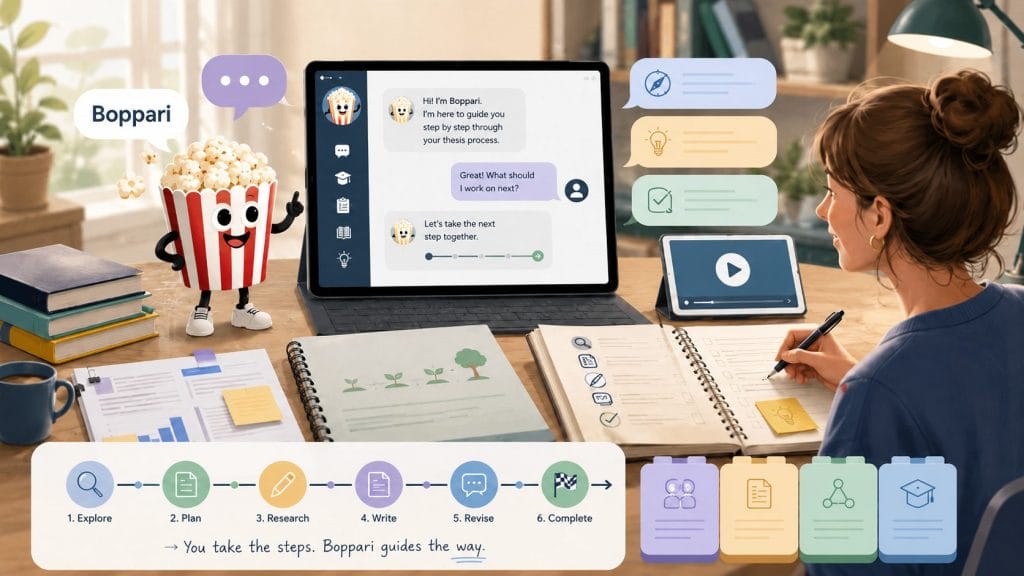
A thesis brings together the competencies students have acquired during their studies, but it also requires independent work, self-management and the ability to make well-founded choices. Students need to understand a lengthy process, identify the next steps and assess their own progress. From the perspective of self-regulated learning, this involves setting goals, planning one’s work, monitoring one’s actions and evaluating one’s learning (Zimmerman 2002; Panadero 2017). These are precisely the points at which the thesis process can become demanding for students.
Recurring questions revealed a need for better support
The self-direction required by the thesis process often becomes visible in supervision as uncertainty and recurring questions. Particularly at the beginning of the process, students tend to ask the same questions: How should I choose a topic? Where can I find a commissioning organization? What should a research plan contain? When should I contact my supervisor? How should I collect data? What does publishing a thesis involve?
From the student’s perspective, these are entirely reasonable questions. From the supervisor’s perspective, however, their recurrence means that a considerable amount of supervision time may be spent repeatedly explaining the same basic aspects of the process instead of focusing on the substantive development of the thesis and supporting the student’s choices.
This intersection between the needs of students and the realities of supervision formed the starting point for developing Boppari. The aim was to create a tool that makes the thesis process visible, helps students proceed in the right sequence and provides support even when a supervisor is not immediately available. The introduction to the Boppari workbook summarizes this need through the questions students ask: “Where do I start, how do I proceed, and how do I know whether I am on the right track?” (Bergström & Jääskeläinen 2025b). These questions are closely connected to the core skills of self-regulated learning: students need to be able to plan their progress, monitor their own work and recognize when they need additional support (Zimmerman 2002; Panadero 2017).
In recent years, chatbots have become increasingly common in education, for example in student guidance, learning support, feedback and access to learning materials. Research nevertheless reminds us that a chatbot does not guarantee high-quality learning. Its value depends on how it is connected to learning objectives, the logic of guidance and students’ active engagement (Lambebo & Chen 2025; Debets et al. 2025). In the development of Boppari, this meant first defining the pedagogical logic of thesis supervision and only then building the technical implementation.
The pedagogical script was at the heart of the development
The most important design choice in Boppari was its pedagogical script. The aim was not merely to create a place for collecting links and instructions. Instead, Boppari was designed to guide students through the thesis process. In the script, the process was divided into stages: welcome and orientation, selecting a topic and commissioning organization, the research plan, theory and language support, empirical work and results, conclusions and the final output, language review and finalization, and finally the presentation and publication of the thesis (Bergström & Jääskeläinen 2025a).
The script included selection buttons for students, videos, guidance documents, downloadable files, links, transitions and prompts directing students to workbook tasks (Bergström & Jääskeläinen 2025a). In this way, Boppari developed into a step-by-step guidance pathway that allows students to return to the sections they need and proceed according to their own situation. When students first start using Boppari, they are advised to go through all sections of the menu. On later visits, they can move directly to the section they need (Bergström & Jääskeläinen 2025a).
This structure made the script the pedagogical core of Boppari. It connected the technical solution with the different stages of the thesis process, support for student progress and the needs identified in everyday supervision. Boppari was therefore not a standalone chatbot, but a guidance pathway structured around the thesis process.
The tone of Boppari is also evident in its script. Rather than addressing students in an official or bureaucratic manner, Boppari aims to lower the threshold for seeking support, encourage students and make the thesis process feel more approachable. It welcomes the student, uses an informal, student-friendly tone, provides guidance on how to proceed and playfully rewards progress with “poppers” – popcorn-themed rewards. This playfulness was not an additional feature detached from the pedagogical design. It was part of the solution, with the aim of creating a tool that motivates students to return to their thesis process.
Clear boundaries made Boppari safer
An important pedagogical and technical decision was made during Boppari’s development: students do not enter open-ended responses into the bot but proceed using predefined options and pathways. This restriction made Boppari pedagogically safer. The bot does not generate thesis content on behalf of the student, assess the student’s text or direct them into an open-ended AI conversation. Instead, it helps the student proceed within a clearly defined thesis process.
This approach is consistent with the principles of responsible AI use. Miao and Holmes (2023) emphasize a human-centered approach to the use of generative AI in education, in which technology is intended to support teachers, students and researchers rather than bypass pedagogical judgment. In Boppari, this meant creating a guided pathway instead of an open AI environment, ensuring that the student’s own work remains at the center of the process.
The limited scope also addresses risks associated with generative chatbots. According to Badger et al. (2026), generative chatbots can provide students with personalized support and immediate feedback, but their use also raises concerns about overreliance on AI, reduced critical thinking, and threats to academic integrity. Boppari’s clearly bounded structure supports students in making progress without producing thesis content on their behalf.
Limiting the functionality did not mean compromising the pedagogical objective. On the contrary, it required the logic of guidance to be scripted carefully: every choice, transition, resource and workbook prompt had to be designed so that the student would receive appropriate support at the right point in the process.
A step-by-step pathway supported progress
Boppari was built as a guidance tool based on menus and predefined pathways. The student’s choices determine what kind of support is offered next. If a student needs help choosing a topic or commissioning organization, Boppari directs them to that stage. If the question concerns the research plan, theory, data collection or publication, the student moves to the corresponding section (Bergström & Jääskeläinen 2025a).
From a pedagogical perspective, it was important that students did not have to search through a large volume of material on their own. Boppari directs them to the relevant stage, where the associated videos, documents and instructions provide support exactly when it is needed. Boppari therefore functions not merely as a chatbot but as a multimedia guidance environment for the thesis process (Bergström & Jääskeläinen 2025a).
The workbook made learning visible
Because Boppari does not store students’ open-ended responses, the workbook became a central component of the overall solution. It addressed a pedagogical challenge inherent in a menu-based bot: if students merely click through options, their progress may remain superficial and temporary. When Boppari directs them to workbook tasks, they must record their thoughts, plan their work and return to their earlier choices as the process progresses.
From the perspective of the development process, the workbook made Boppari more than a collection of materials organized into pathways. The bot directs students to the appropriate stage, while the workbook provides a lasting record of their thinking. In this way, Boppari supports both progress and students’ awareness of their own thesis process.
Testing validated Boppari’s pedagogical approach
Boppari was first tested in the business unit and later across Xamk. In the expanded testing phase, a survey was sent to 72 testers, of whom 34 responded. In addition, 10 students responded to a separate student survey. The results of the student survey are examined in more detail later in this article series (Bergström 2025).
Testing highlighted Boppari’s clarity, visual appeal, motivational qualities and ability to make the structure of the thesis process visible. Of the respondents, 88% felt that Boppari helps students make progress with their thesis and reduces uncertainty at different stages of the process. Teachers and supervisors also viewed Boppari as a guidance tool that can harmonize supervision practices and reduce repetitive routine work (Bergström 2025).
At the same time, the feedback identified areas for further development. A shared structure can support the thesis process across different fields, but it needs to be complemented by discipline-specific interpretation, program-specific instructions and the expertise of the supervisor. This observation reinforced Boppari’s underlying principle: a bot can make the process visible, but it does not eliminate the need for human guidance.
Boppari does not replace the supervisor but shifts the focus of supervision
A central pedagogical principle in the development of Boppari was that the bot should not replace the thesis supervisor. Its role is to answer recurring basic questions, structure the student’s progress and help the student prepare for supervision meetings. When students already have access to basic information and can see the structure of the process before a meeting, supervision time can be used more effectively for developing the content of the thesis, discussing and justifying choices, and supporting the student’s own thinking.
Boppari does not reduce the importance of supervision; rather, it shifts its focus. It helps move supervision away from repeatedly providing basic process information and toward88 expert dialogue in which the supervisor supports the student’s decisions, research skills and thinking and the development of thesis quality.
More broadly, Boppari demonstrates that the value of an educational chatbot does not arise from technical functionality alone. What matters is the pedagogical task for which the bot is designed and how clearly its boundaries are defined. Boppari supports students in moving forward but does not produce thesis content on their behalf.
What did we learn from developing Boppari?
The development of Boppari demonstrated that an educational chatbot should first be designed as a pedagogical solution and only then as a technical one. If the starting point had merely been the technical possibility of building a bot, the result might have been little more than a collection of links or an automated FAQ tool. By starting instead from the logic of thesis supervision, Boppari became a step-by-step tool for supporting learning and progress. This supports the observation by Debets et al. (2025) that the value of an educational chatbot cannot be assessed solely in terms of technical functionality but must also be considered in relation to its pedagogical and theoretical foundations.
A second key lesson concerns boundaries. Boppari does not do everything, nor should it. It does not write or assess the thesis, provide individual guidance on research methods or replace the supervisor. Instead, it structures, guides, motivates and reminds. This clear scope makes its use pedagogically safer and easier to understand.
A third lesson concerns complementary materials. Chatbot interaction alone is not sufficient when the aim is to support a long-term learning process. The workbook makes Boppari’s guidance more persistent. Students can return to their own notes, monitor their progress and make their own thesis process visible.
- Idea and need. Boppari originated from a recurring observation in thesis supervision: students need clear, step-by-step and easily accessible support, particularly at the beginning of the process.
- Pedagogical script. Boppari was structured according to the stages of the thesis process. The script included menus, student choices, transitions, videos, documents, links and tasks directing students to the workbook.
- Technical implementation. Boppari was implemented as a guidance tool based on menus and predefined pathways. Students do not enter open-ended responses into the bot but proceed using predefined options.
- The workbook as an integral part of Boppari. The workbook complements the bot. It helps students record their thoughts, plan their work and reflect on their own thesis process. The workbook originally used alongside the bot was also adapted into a more general version that can be used independently. It was published in the Xamk Learning Materials series on 31 December 2025.
- Testing and implementation. Boppari was first tested in the business unit and later across Xamk. Following the testing phase, its implementation began in early 2026 based on a decision by the Education Management Team.
- Key lesson. The crucial factor in developing a chatbot is not the technology but the pedagogical logic: what students need to understand, in what sequence and with what kind of support.
How Boppari was developed
Boppari is a chatbot developed at South-Eastern Finland University of Applied Sciences (Xamk) to support the thesis process. Its purpose is to help students progress step by step from starting their thesis through to publication and graduation. Boppari does not write the thesis on behalf of the student or replace the thesis supervisor. Instead, it directs students to the appropriate materials, tasks and points for reflection.
The pedagogical script for Boppari was developed by Heli Bergström and Pia Jääskeläinen in autumn 2024. In spring 2025, Boppari was tested in the business unit, and in autumn 2025 the testing was expanded across Xamk. Following the testing phase, implementation began in early 2026 based on a decision by the Education Management Team.
In addition to the chatbot, Boppari includes a student workbook, videos and guidance documents. Together, these form an integrated guidance environment supporting the thesis process.
What did we learn?
A chatbot should be built around a pedagogical need. A bot designed for educational use should not be merely a technical solution or a collection of links. It should be based on an understanding of the learning process, student’s guidance needs, and how students progress.
Clear boundaries make a bot safer and more useful. Boppari does not replace the supervisor or write on behalf of the student. A clearly defined role helps both students and teachers understand what the bot is intended for and where human guidance is still needed.
The strongest support comes from combining the bot with the workbook. The bot directs the student to the appropriate stage and resources. The workbook prompts the student to stop, think, document their ideas, and reflect. Together, they make the thesis process more visible and manageable.
AI use disclosure: ChatGPT was used to support the language editing and proofreading of the English translation. The author reviewed and approved the final text.
Lähteet
References
Badger, M., López, N. & Rønne Nissen, C. F. 2026. The Impact of GenAI Chatbots on Student Learning in Higher Education: A Literature Review. International Journal of Technology in Education, 9(1). https://doi.org/10.46328/ijte.5111
Bergström, H. 2025. Boppari – Laajennetun testauksen yhteenveto pedagogiselle johtoryhmälle. Unpublished report.
Lisenssi
Teema
Viittausohjeet
Bergström, H. 2026. Boppari supports students through the thesis process. Boppari article series, 1. TEKO online publication. South-Eastern Finland University of Applied Sciences. Available at: https://urn.fi/URN:NBN:fi-fe20261125149777