
Can mushrooms sing? Bioelectrical signals as a component in creative work
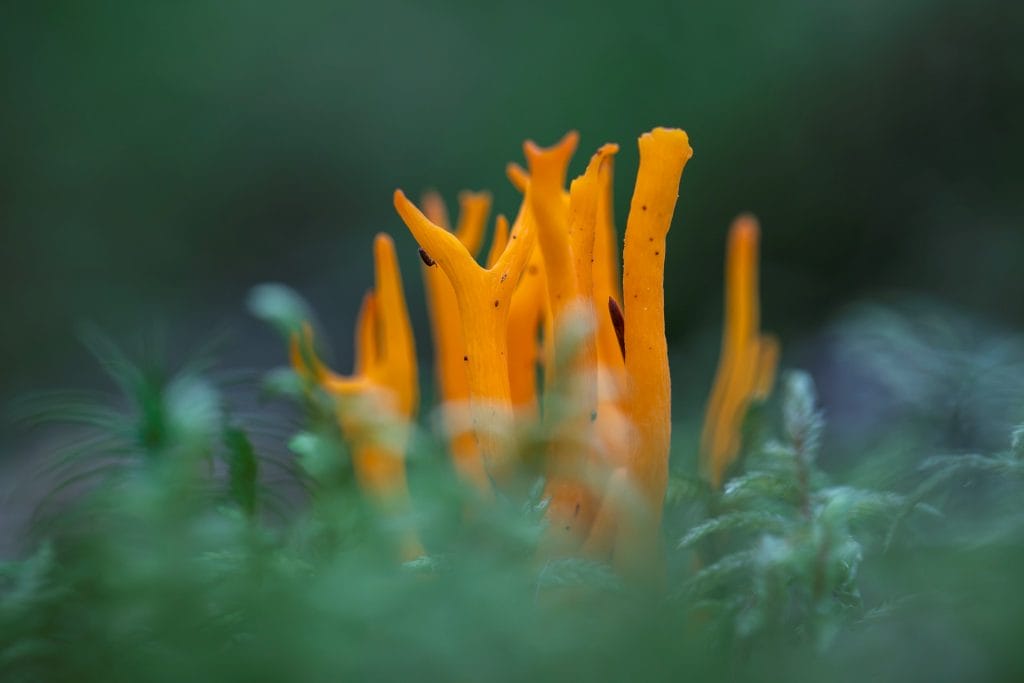
Mycelium, the root-like vegetative body of fungi, has intriguing applications as a sustainable construction material. However, its favourable properties, including being lightweight, a good thermal insulator and its ability for acoustic absorption, are still being researched and remain largely unknown to the public. To increase interest in this novel material, the idea to make the mycelium growth process audible came up.
Mycelium is known to generate a variety of electrical signals that even exhibit characteristics resembling human language (Adamatzky 2022). Therefore, it seemed feasible to record and process these signals as components in musical experiments.
Therefore, a biodata sonification device was built based on readily available instructions (Cusumano 2021). While the device produced an interesting audible output, it became clear that it responded primarily to electromagnetic noise picked up from the ether rather than to the electrical signals generated by the living mycelium (Bircher 2026). Thus, the process utilising such a device can hardly be called biodata sonification.
After the disappointing results with the biodata sonification device, a new way to convert mycelium’s activity into music had to be found.
Approach and implementation
To record the mycelium’s activity during growth, two approaches were selected to increase the likelihood of obtaining usable data: recording audible signals using electret microphones and measuring the electrical resistance of the mycelium using wire electrodes. Both the microphones and electrodes were embedded in the substrate to be grown in the mycelium.
The microphones were connected to a digital audio recorder. However, nearly 150 hours’ worth of recordings, visualised with a spectrum analyser, yielded only environmental noise. No audible evidence of the mycelium’s growth could be detected.
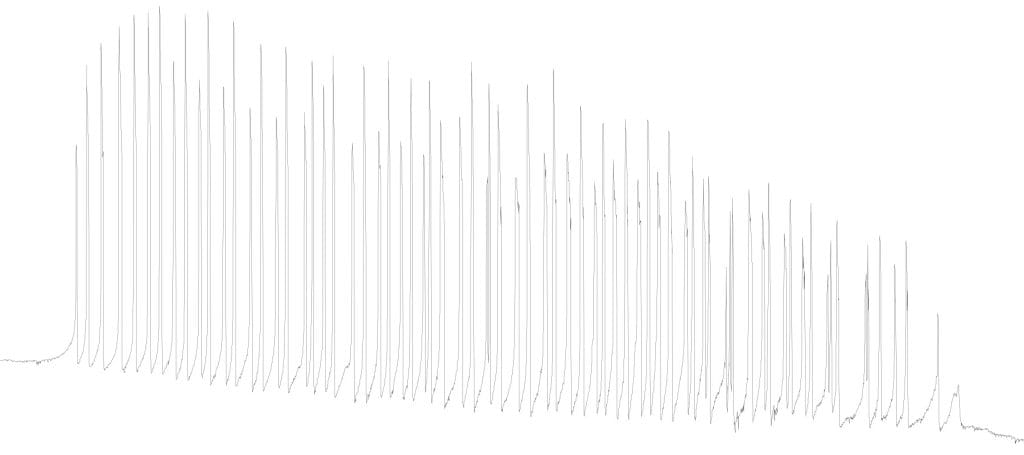
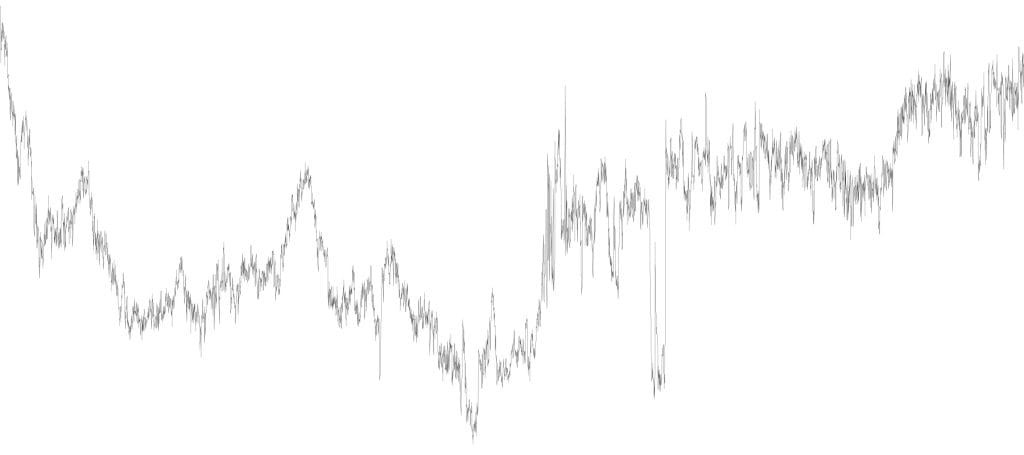
In contrast, a sequence of over 50,000 measurements collected over 57 hours of partial growth activity looked more promising. After 14 hours, the recorded data showed bursts of spikes (Bircher 2026), as observed in earlier research (Adamatzky 2018). These bursts have interesting audible qualities due to their oscillation characteristics and sound distinct when sped up and converted to audio waveforms. The resulting waveforms (see Figure 1) can be loaded into a software audio sampler to serve as the voice of a unique instrument. In addition, other recorded waveforms (see Figure 2) can serve as sources to modulate the pitch of these voices, thereby generating melodies.
Results
The recorded waveforms of mycelial bioelectric activity enable the creation of audible outputs from the mycelium itself. The method used allows the selection of different parts of waveforms with increased activity and scaling their amplitude and tempo to create an interesting listening experience.
Due to the slow change in the electrical signals measured, it is, however, not practicable to use life signals from the mycelium to generate melodic results in real time, as suggested for the initially tested device. The mycelium’s bioelectric activity does not seem to correlate with its sonic output (Bircher 2026).
Discussion
Unlike a singing bird, the mycelium itself does not produce perceivable sounds. The sonification of its bioelectric signals requires creative intervention through the curation of recorded waveforms, which significantly influences the result. Hence, it is debatable whether the resulting sounds could be labelled as ”mushroom music” or ”mycelium music”.
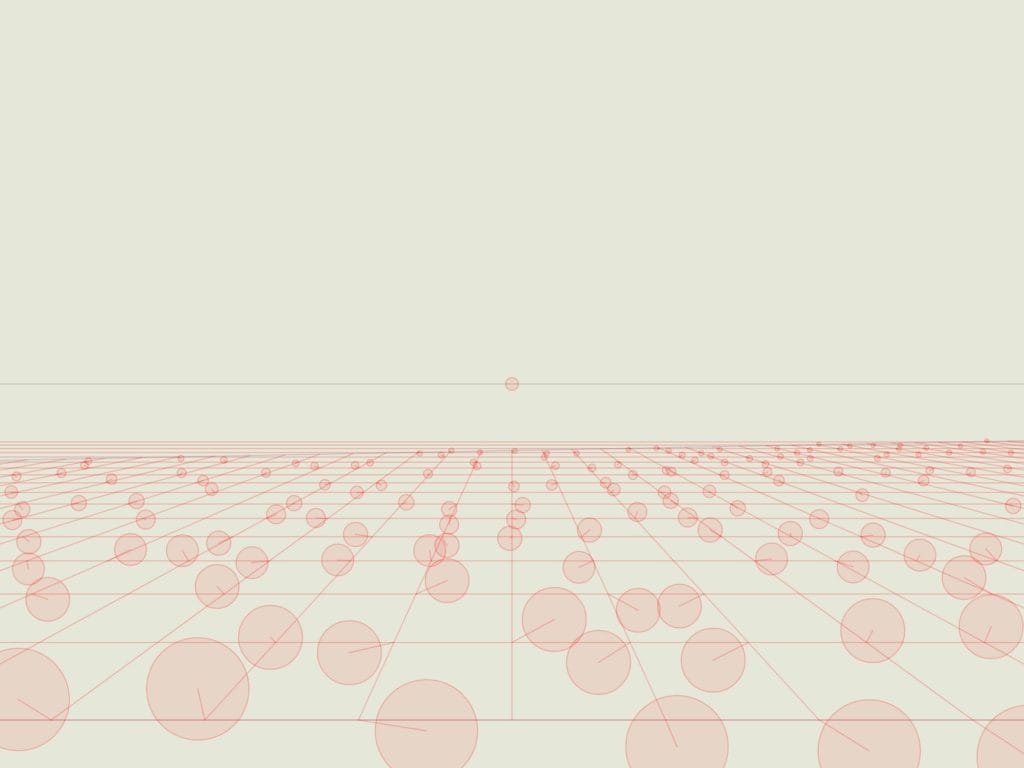
In many generative art forms as well as in generative design, it is common to append random elements to the rigid structures defined by an algorithm, enriching the results with seemingly organic variation (see Figures 3 and 4). These random values, however, are based on mathematical operations and originate from a computing processor. Consequently, suitable recorded hard data could replace randomness, thereby meaningfully influencing creative outcomes.

Combining data analysis with the arts can offer valuable opportunities to visualise complex scientific facts and make them more accessible to a broader audience. It should also be noted that some artists base their work preliminarily on scientific data (Miebach 2011).
Conclusions
Using bioelectrical signals to draw interest to mycelium by creating music proved a feasible solution. This worked, however, because interesting bursts of spikes could be recorded and detected between long periods of low electrical activity of the mycelium, which can be attributed to some luck.
Capturing signals that fit the desired purpose may require experimentation, and there is no guarantee of success.
While this research used a laboratory-grade measuring instrument, similar results can be achieved on a smaller budget, for example, with an Arduino and some programming skills.
At the low-tech end, even a pen attached to a pendulum that sways in the wind can produce visual work influenced by the weather (Gammans 2025).
In conclusion, this interdisciplinary approach illustrates how real-world data can serve as an integral ingredient in creative work and how measuring physical variables and data literacy can augment the artist’s toolbox.
Figures
Figure 1. Example of a recorded waveform that can be used as the voice (Source: Author, 2026).
Figure 2. Example of a recorded waveform that can be used as the melody (Source: Author, 2026).
Figure 3: Study for an algorithmic birch forest illustrating the deviation of tree positions from the initial grid using random values (Source: Author, 2024).
Figure 4: Study for an algorithmic birch forest at a later stage with rendered tree trunks (Source: Author, 2024).
These experiments were conducted as part of the “Experimental environments for climate-responsible outdoor structures” project, in which the use of mycelium plays a pivotal role. The project is funded by the Regional Council of Kymenlaakso and co-funded by the European Union.
The research featured in this article has been examined by the Author in a second publication, which highlights the technological aspects of the experiments conducted (Bircher 2026).
Read also
Bircher, M. 2026. Method for recording bioelectrical signals in fungal mycelia.
Lähteet
Sources
Adamatzky, A. 2018. On Spiking Behaviour of Oyster Fungi Pleurotus Djamor. Scientific Reports, vol. 8, no. 1, May 2018, p. 7873. Available at: https://doi.org/10.1038/s41598-018-26007-1.
Adamatzky, A. 2022. Language of fungi derived from their electrical spiking activity. R. Soc. Open Sci. 9: 211926. Available at: https://doi.org/10.1098/rsos.211926.
Bircher, M. 2026. Method for recording bioelectrical signals in fungal mycelia. Kesto publication channel. Southeastern Finland University of Applied Sciences. Available at: https://urn.fi/URN:NBN:fi-fe20260923128292
Cusumano, S. 2021. BiodataSonificationBreadboardKit. GitHub. Available at https://github.com/electricityforprogress/BiodataSonificationBreadboardKithttps://github.com/electricityforprogress/BiodataSonificationBreadboardKit [Accessed: 11.6.2026].
Gammans, J. 2025. LIVE Wind Drawing at Venue 26 [Video]. Instagram. Available at: https://www.instagram.com/p/DO0-0GrCIWF/ [Accessed: 9.6.2026].
Koivisto, T.-A. and Tähti, T. 2024. Taide ja kulttuuri edistävät terveyttä ja hyvinvointia. Lääkärilehti, 79(47-48), e42185. Available at:https://taju.uniarts.fi/handle/11111/418.
Miebach N. 2011. Art made of storms [Video]. TED. Available at: https://www.ted.com/talks/nathalie_miebach_art_made_of_storms [Accessed: 9.6.2026].
Lisenssi
Teema
Viittausohjeet
Bircher, M. 2026. Can mushrooms sing? Bioelectrical signals as a component in creative work. Elo-verkkojulkaisu. South-Eastern Finland University of Applied Sciences. https://urn.fi/URN:NBN:fi-fe20261001130311