The world in the desired future
The warm-up phase of coaching and reflection on future phenomena aims to have participants realise how many different opportunities can be associated with the future. Once this goal has been achieved, it is time to discuss what kind of future young people would like to see.
The following questions can be considered both in general at the global and humankind level, but also at the personal level.
What kind of things could make up a good future? What should change? And what thing would be desirable to remain unchanged, even if the world otherwise becomes radically different?
Forming a vision for a good future, even a vague one, plays a key role in future coaching.
The aim is that each young person participating in the coaching programme can identify a few individual matters that they believe are essential for a good future. These can be very concrete things, such as one’s own home, safe relationships or a reliable livelihood.
On the other hand, the vision of a good future may also be manifested at a more general level. For some, the idea may be that environmental challenges and climate change could be prevented, or that, despite the tremendous development of technology, direct interaction between people would be maintained.
It is worthwhile spending time with the participants to envision a good future, as it often involves major reflections on what is ultimately important for a meaningful life.
This reflection is worthwhile, as the end result is often significant insights about one’s own values and the direction in which one would like to move forward in life.
Reflection questions for the coach:
- What kind of things would make up your vision of a good future? What kind of sensory experiences (sight, hearing, smell, taste or touch) would be associated with a good future?
- What things would you like to see become different in the future than they are now?
- What things would you like to keep the same as they are now, even if the world would become radically different in the future?
Example of the duration of the exercise: 1–1.5 hours
Supplies: Two photos, one from the past (e.g., 50 or 100 years ago) and one from today. The photos do not need to be from the same location, but this is recommended, as it inspires participants to see what has changed over time. In addition, example photos taken at the same location in the centre of Mikkeli can also be used in the exercise. In addition, one empty sheet of paper or a silhouette of an urban landscape is needed. The silhouette can be used as an example.
Goal: In this exercise, participants reflect on their desired future by envisioning and describing the city of the future on paper. By examining history and the present, the aim is to form an urban view that the participants hope to see in the future.
Implementation
The participants can complete the exercise independently or as a group. It is recommended to have a debriefing session at the end of the assignment, where the participants can share their thoughts about the city of the future.
Before the assignment, it is a good idea to discuss future phenomena and thoughts related to the future with the participants. The assignment can also be implemented at the beginning of the coaching, in which case, the vision of the future urban landscape can be complemented as the coaching progresses.
Instructions for the participants:
- Look at these photos from 1908 and 2022 (if using the example photos).
- Think about the changes that have taken place in the world between the two photos. What things may have remained unchanged?
- Take a blank sheet of paper or a cityscape silhouette. Imagine looking at the same city in the future.
- Draw or write things on the image you wish to see in it. What is the city of the future of your dreams like?
- You can also imagine what you sense when travelling in the city of the future. What will you hear there? What will it smell like? What tastes could there be?
- Present your work to others. What kind of things did you describe? Why?
Alternatively, the participants can discuss what could be seen in the city of the future. What could a city of the future be like, according to the participants? And what version of it would they not want to see?
Debriefing discussion
The following questions can be considered in the debriefing discussion:
- How do the cities envisioned by the participants differ from one another?
- What has changed in the cities since the present time, and what has remained unchanged?
- What kinds of measures are needed in order for the change that young people envisioned to take place?
- How should values, attitudes and practices change?
- How can everyone influence future development through their own actions and choices?
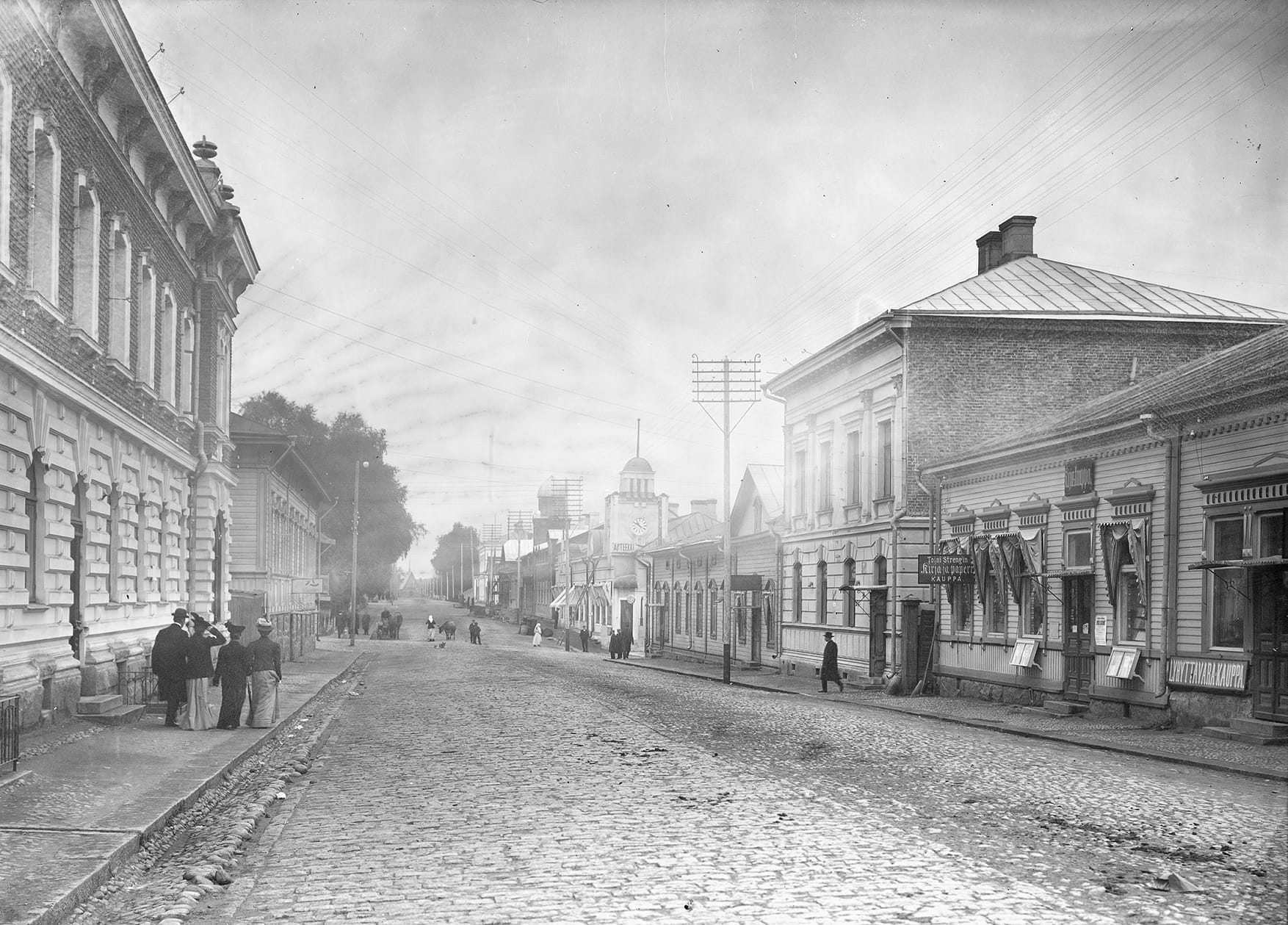
Porrassalmenkatu, Mikkeli, Finland 1908. M. L. Carstens, 1908. Historical
picture collection, M. L. Carstens collection. https://www.finna.fi/Record/museovirasto.602C8956C536C414F0C6856CA44266F7?sid=4667582343
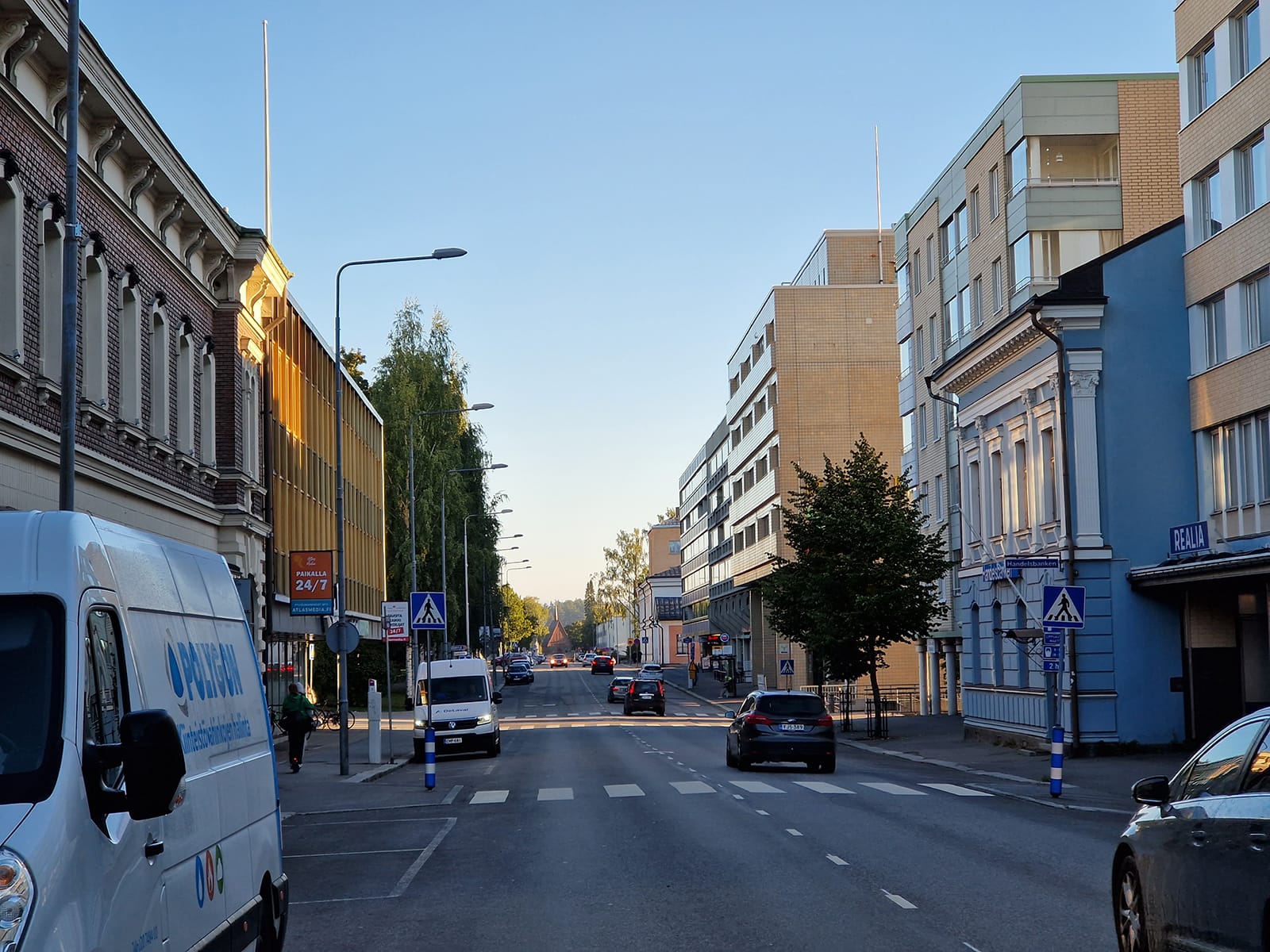
Porrassalmenkatu, Mikkeli, Finland 2022. Ville Eerikäinen, 2022.
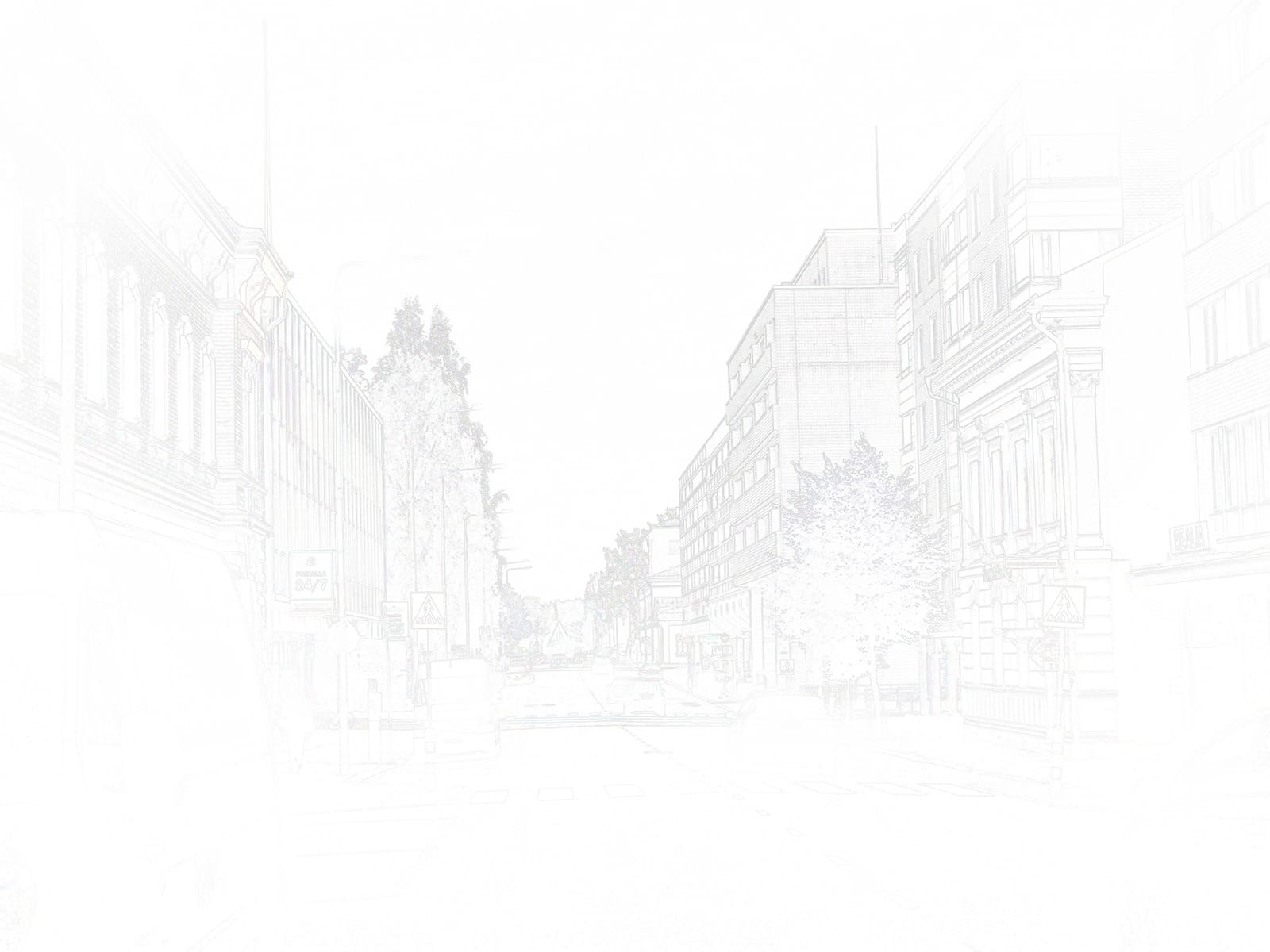
Edited, black-and-white urban landscape: Ville Eerikäinen, 2022.
Example of the duration of the exercise: 30 minutes–1.5 hours
Supplies: Paper, pens, pencils, craft accessories.
Goal: Form a vision of a desired and meaningful future that is as vivid as possible by describing it in the form of a story, either as text or visually.
Implementation
The coach can either read the story frame below to the participants or distribute it to them on paper. The participants can reflect on and form answers to the questions below, for example by writing or drawing. If they so wish, they can share their vision with others.
During the assignment, the coach should take into account: There are no wrong answers or wishes! The most important thing is that participants describe their own thoughts, not what they expect others to want.
Story body: A day in a good future
Congratulations! You wake up in the morning at your home, in a good future (you can decide for yourself how far ahead this moment is).
In the good future, things have gone more or less according to your wishes, and the world around you has developed in a positive direction.
What kinds of things make this a good future?
- Describe the environment in which you wake up. What will your home be like in the future?
- What kind of sensory observations do you experience when you wake up? For example, what do you hear or smell at home in the good future? And what do you feel or see?
- What kind of place is your home in the good future? What do you see when you look out the window
- You’ve woken up to go somewhere. Where are you going in the morning in the future? Describe your trip as you go there. For example, what means of transport do you use?
- What are the most important highlights of your day in the future? Describe in as much detail as possible.
Example of the exercise duration: The duration depends on the creative method chosen by the group to make future visions visible. However, it is advisable to reserve plenty of time for the exercise so that young people can carefully work on their own thoughts.
Supplies: Depends on the creative method chosen by the group to make future visions visible.
Goal: This exercise is a continuation of the previous exercise, A Day in a Good Future. The aim is to make the future visions and wishes produced by the participants concrete, visible outputs using creative and art-based methods. Making visions visible strengthens the participants’ perception that their thoughts about the future are important and deserve to be seen and heard.
Implementation
This exercise can be divided into several coaching meetings, for example, so that half of the time is reserved for other exercises and the other half for working on a joint output. The participants can also work on material for a joint output as a homework task between coaching sessions.
It is also worth highlighting in the implementation how this concrete cooperation develops the different skills and competences of young people. For example, cooperation between the participants can support the development of social skills, and experimenting with new things strengthens their competence identity, which is described in more detail later in this guide.
Instructions to the participants when planning the joint output:
- Bring together the visions of the exercise, ‘A Day in a Good Future.’
- Think about and discuss: What would the world be like if the visions formed by all participants were visible there? What do you find positive in there? And what kind of threat scenarios can there possibly be?
- Think together about how the visions could be made visible and select the methods you want to use.
The participants can use different methods to make their future visions visible according to the possibilities of the coaching environment. The methods may include handicrafts, object design, crafts, painting, drawing and digital art, photography, video or short film.
The proposals are indicative examples, and the group can easily choose another creative method that interests them.
Encourage participants
The coach’s task is to encourage the participants to boldly experiment with new methods and ensure that everyone can participate in joint activities according to their own willingness and capabilities.
In the implementation of the work, a responsible and ethical perspective can also be taken into account, for example, by using recycled materials.
Instructions to the participants when creating the joint output:
- Produce a joint output describing the world of the future in which the vision formed by each participant can be seen in some way.
- Finally, consider together how you want your work to be visible to other people. Where could it be on display, and how could others experience it? How could the work encourage others to think about the future?
- Reflecting on work in a group and individually: What has been the experience of working on a piece together? What new skills have been learned during the work? What was your role like?
Exercise can be demanding
Making visions visible is at best a rewarding experience that produces experiences of success. On the other hand, this exercise may be relatively demanding for young people, as it requires cooperation skills and the courage to make the result of one’s own work visible to others.
The coach’s role during the work is to support and encourage the participants, ensuring that the work does not generate anxiety and that the participants do not drift too far outside their comfort zone.
Example of the duration of the exercise: 1–2 hours
Supplies: Phone or camera.
Goal: In this exercise, participants are prompted to reflect on different futures and identify what aspects they would like to see differently in the future, as well as what aspects they would like to remain the same as they are today.
Implementation
The participants can complete this exercise as an independent homework assignment. The exercise can also give people a reason to go outdoors for a while during a coaching session.
Instructions to the participants:
- Each participant takes two photos (e.g., with their own phone).
- One photo (either concretely or in a more symbolic way) represents something that the participant would like to see change in their own future. The other photo, on the other hand, represents something the participant would like to see remain as it is in their own future.
The coach determines how much time is available for taking photos depending on the situation.
Debriefing
The task can be debriefed in different ways. One way is for the participants to present the photos they have taken and explain their thinking process related to them.
The coach can use the photos and the thoughts of the participants related to them later in other exercises. If the coaching group wants, the photos can be used as a small-scale exhibition or as material in the group’s community art project.
Example of the duration of the exercise: 30 minutes–1.5 hours
Supplies: You can apply almost any deck of value cards in this exercise. The coach can easily find different options online!
Goal: Prompt participants to think about what kinds of things and values are important and how they are reflected in their own futures thinking.
Implementation
Matters that are important and meaningful to the participants can be mapped using, for example, a value card deck. The aim is to identify distinct values within a large group that are meaningful to each individual young person. The participants can also discuss their thoughts with others.
At the beginning of the assignment, the coach should emphasise to the participants that there are no right or wrong answers and that their values do not need to be the same as those of others. Instead, it is essential that the participants find and reflect on matters that are important to them.
Instructions to the participants
- Read the value cards carefully and consider the values that are important to you.
- For example, choose three values that are important to you.
- Select at least one value that is not very important to you. Think about why it does not feel significant to you.
- Think about how the values that are important to you are reflected in your own life.
And how are they visible in society? Should they be more visible? - Present your selected values to your partner, coach, or the rest of the group.
Discuss what you found in common in the value cards. And what differences did you notice?
License
Theme
Kestävä hyvinvointi ja tulevaisuus, Nuorisotyö, Tulevaisuustyö, Yhteisöllinen hyvinvointi ja osallisuus
Citation instructions
Rantaniva, A. ja Eerikäinen, V. 2025. Future Coaching Guide. Xamk Educate 6. South-Eastern Finland University of Applied Sciences. Available: https://urn.fi/urn:nbn:fi:oerfi-202509000000780_2.
ISBN
978-952-344-624-3